
Attic mold rarely announces itself. Nobody goes up there in July, and by the time a ceiling stain or musty smell shows up, the leak behind it may be a season or two old. Santa Rosa's weather makes that pattern especially common.
Santa Rosa's rain comes all at once
NOAA's 1991–2020 normals for Santa Rosa show about 31.53 inches of rain a year. December (6.47 inches) and February (6.39 inches) are the wettest months, followed by January (5.78 inches). About 83% of the year's rain falls from November through March. From June through September the city averages only 0.49 inches in total.
| Period | Average rain (in.) | What it means for the attic |
|---|---|---|
| November–March | 26.15 (83% of the year) | Leaks, wind-driven rain and condensation on cold roof sheathing |
| April–May | 3.26 | Damp wood stays damp as storms taper off |
| June–September | 0.49 | Surfaces dry, stains fade, leaks go unnoticed |
NOAA 1991–2020 monthly normals, Santa Rosa station. October averages 1.63 inches.
Atmospheric river storms make it worse. The February 2019 storms pushed the Russian River at Guerneville to a 45.38-foot crest and brought a federal disaster declaration, and the January 2023 storms brought another round of roof leaks, fallen trees and saturated ground across the county.
Two ways winter puts water in the attic
Roof leaks. Rain gets past worn shingles, failed flashing at chimneys and vents, skylights, roof valleys or a branch strike. The water soaks the sheathing and insulation in one spot, usually with a clear drip path.
Condensation. Winter nights in Santa Rosa average in the upper 30s (January lows about 38°F). Warm, moist air from the house rises into the attic and hits cold roof sheathing, where it condenses. Bathroom or dryer fans that vent into the attic, blocked soffit vents, gaps around ceiling lights and missing insulation all add to it. Condensation mold tends to spread evenly across the sheathing, often on the north side and near the eaves.
| Clue | Points toward a leak | Points toward condensation |
|---|---|---|
| Pattern of staining | One area, often below a vent, chimney or valley | Broad, even darkening across many rafter bays |
| Insulation | A wet or matted spot | Dry insulation, damp wood above it |
| Nails | Rust near the leak | Rusty or frosty nail tips across the roof |
| Timing | Drips during or right after rain | Worst on cold, still mornings |
Many attics have both. A good inspection sorts out which one you have, because the fix is different: a roofer for the leak, ventilation and air sealing for condensation.
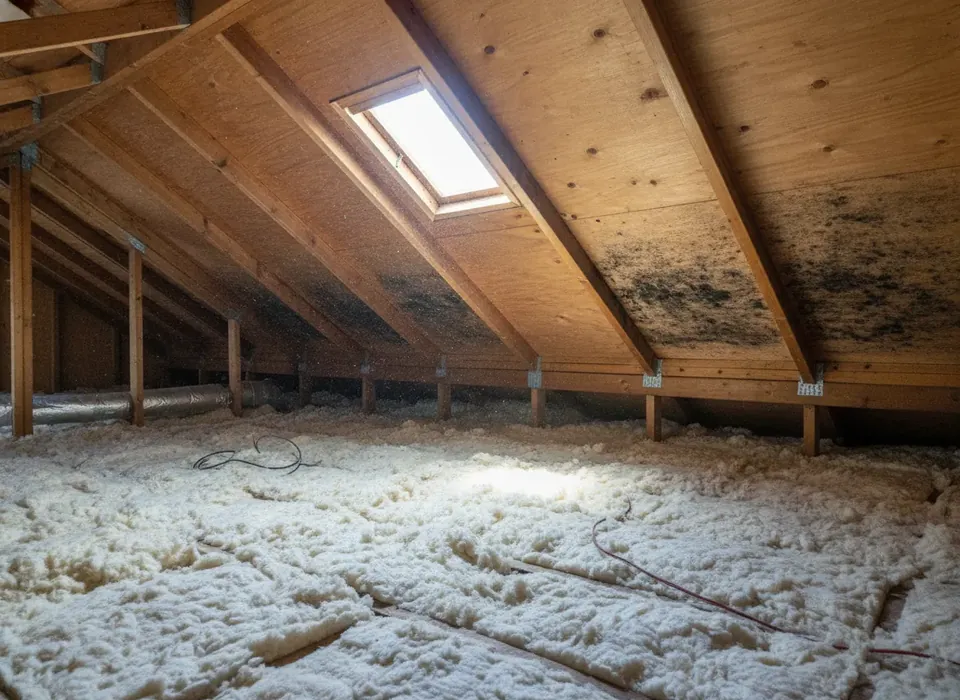
Signs of attic mold
- A musty smell when the heat first runs in October or November.
- Water stains or spots on top-floor ceilings, especially near exterior walls.
- Black, gray or green spotting on the underside of the roof sheathing or rafters.
- Damp, compressed or stained insulation.
- Rusty nails, or frost on nail tips on cold mornings.
- Peeling paint or swelling at the eaves.
What to do after a winter storm
Safety first. Do not walk on a wet roof. If a ceiling is sagging or bulging with water, keep people out of the room and turn off power to fixtures in that area. Step only on joists in the attic, and wear a mask and gloves if you see mold.
Catch and stop the water
Put buckets under drips and have a roofer tarp the roof if needed.
Take photos
Photograph the ceiling, the attic and the roof from the ground, with dates. Insurers usually treat sudden storm damage differently from a worn roof.
Dry it fast
EPA advises drying wet materials within 24 to 48 hours to prevent mold. Pull out soaked insulation and use fans if you can do so safely.
Recheck after the next storm
A quick look with a flashlight during a hard rain can reveal a drip path that a dry-day inspection misses.
Our post on whether homeowners insurance covers mold explains how insurers usually treat storm damage versus long-term leaks.
How attic mold is usually handled
The companies we connect you with typically start with an inspection and moisture readings, then a written scope. A common sequence:
- Fix the roof or flashing first, usually by a roofer. Roof repairs often need a permit; ask the contractor or your building department.
- Correct ventilation: clear soffit vents, reroute bath fans outdoors and seal air leaks from the house below.
- Set up containment where needed so attic dust does not drop into living spaces.
- Remove wet or moldy insulation, then HEPA-vacuum and clean or treat the sheathing. Badly damaged sheathing may need to be replaced.
- Dry, verify with moisture readings, and in many cases run a clearance check before new insulation goes in.
See our attic and roof-leak mold page for more on what each step involves.
What attic mold remediation costs
Published guides put attic mold remediation at about $1,000 to $4,000 (This Old House 2026), with remediation generally running $10 to $25 per square foot (This Old House 2026; Fixr 2025). Roof repair, new insulation and ventilation work are usually separate. These are national published estimates, not quotes; North Bay labor and disposal may run higher. Our Santa Rosa mold remediation cost guide has the full table and a calculator.
Any job of $1,000 or more must be done by a CSLB-licensed contractor. Our guide to hiring a CSLB-licensed contractor covers down payments and cancel rights.
Newer homes are not immune
About 2,900 Santa Rosa homes were destroyed in the 2017 Tubbs Fire, and many were rebuilt quickly, often through wet winters. New-construction roofs can still have flashing details that leak or bath fans that end in the attic. If your rebuilt home has a new musty smell, see our fire rebuild moisture and mold page.
Older homes have their own issues. Half of Santa Rosa's housing was built before 1980, so before old insulation or ceiling material is disturbed, ask whether an asbestos survey makes sense.
Attic mold questions
Why does my attic get moldy in winter in Santa Rosa?
Two reasons. About 83% of Santa Rosa's rain falls from November through March, so roof leaks show up then. And winter nights average in the upper 30s, so warm, moist house air condenses on cold roof sheathing, especially when bath fans vent into the attic or soffit vents are blocked. The dry summer then hides the damage until the next season.
Is attic mold dangerous?
The EPA and CDC say mold can irritate the nose, throat, eyes and lungs in sensitive people and can be more serious for people with asthma or weakened immune systems. Attic mold is usually separated from living space, but air leaks can carry spores down. Keep children and pets out of the attic, and see a doctor if anyone has symptoms.
Can I clean attic mold myself?
EPA suggests homeowners can usually handle mold areas under about 10 square feet. Attic mold is often larger than that and hard to reach, and the dust is easy to spread. Fix the leak or ventilation first either way. For anything larger, or any job of $1,000 or more, California requires a CSLB-licensed contractor.
Does insurance cover attic mold from a roof leak?
It depends on the cause. The California Department of Insurance guide lists sudden and accidental water damage as typically covered, but mold, wear and tear, and water from seepage or leaks as usually excluded. Sudden storm damage may be treated differently from an old roof that leaked for months. Report damage promptly and ask your insurer how your policy applies.
Found staining in the attic?
Tell us where the staining is, whether you have seen drips and when the roof was last replaced, and independent companies across Santa Rosa, Windsor, Sebastopol and Sonoma County will reply with free quotes. Request a free quote or call (707) 896-6015. Santa Rosa Mold Pros is a free quote service: we pass your request to independent Santa Rosa, California area companies, and we do not inspect, remove mold or do construction work ourselves.