
You found mold after a leak, a storm or a winter you would rather forget, and you want to know whether your homeowners policy will help. The honest answer is "sometimes, and it depends on the cause." This guide uses the California Department of Insurance (CDI) Residential Insurance Guide, revised January 2026, to explain how policies usually work. Your own policy is what decides your claim.
No promises here. Santa Rosa Mold Pros is a free quote service. We are not an insurer, agent, adjuster or law firm, and nothing on this page means a claim will be paid. Ask your insurer or agent how your policy applies.
The short answer from the CDI guide
The CDI guide lists perils that are usually excluded from California homeowners policies: "Earthquake, flood, mold, earth movement, and 'wear and tear' are some of the perils that are usually excluded."
On water, the guide draws a clear line. "Sudden & accidental water damage" is listed as typically covered. Water damage caused by seepage or leaks is listed as not covered, and so are losses to a house left vacant for 60 days or more.
Put together: mold is usually excluded on its own, but if it follows a covered, sudden and accidental water loss, some or all of the cleanup may be handled as part of that claim, depending on your policy's wording and any mold limit it carries.
How common Sonoma County situations usually play out
| What happened | How policies usually treat the water | What that tends to mean for mold |
|---|---|---|
| Washing machine hose or supply line bursts | Sudden and accidental; typically covered | Mold cleanup may be part of the covered repair, subject to policy limits |
| Slow drip under a sink or behind a toilet for months | Seepage or leaks; usually not covered | Usually not covered |
| Winter storm damages the roof and rain pours in | Depends on the cause and the policy | Often follows the decision on the roof damage |
| Old roof wears out and leaks a little each storm | Wear and tear; usually excluded | Usually not covered |
| Russian River or creek water enters the house | Flood; not in a homeowners policy, needs separate flood insurance | Not covered by the homeowners policy |
| Cabin left closed 60+ days, leak found later | Vacancy over 60 days is listed as not covered | Usually not covered |
| Condensation, poor ventilation, high humidity | Maintenance issue; generally excluded | Not covered |
General patterns based on the CDI Residential Insurance Guide (Form 401, rev. January 2026). Your policy language controls, and only your insurer can say what it will pay.
Why the dry season makes claims harder here
Santa Rosa, California averages about 31.5 inches of rain a year (NOAA 1991–2020 normals), and about 83% of it falls from November through March. June through September brings less than half an inch in total.
That pattern hides leaks. A roof or window leak that starts in a February storm can dry on the surface by summer while mold keeps growing inside the wall. When you finally notice a musty smell in October, the insurer may see months of seepage rather than one sudden event. Reporting water problems as soon as you see them is the best protection you have.
Floods need separate flood insurance
The CDI guide says flood coverage is generally not provided in a homeowners or renters policy. Federal flood insurance through the National Flood Insurance Program (NFIP) is separate, with maximums of $250,000 for the structure and $100,000 for contents.
That matters along the Russian River. At Guerneville the river crested at 45.38 feet on February 27, 2019, well above the 32-foot flood stage, and about 1,900 homes across Sonoma County were affected. If you live near the river, Laguna de Santa Rosa or the Petaluma River, ask your agent about flood coverage before the next wet season. See our post on mold after Russian River flooding for cleanup steps.
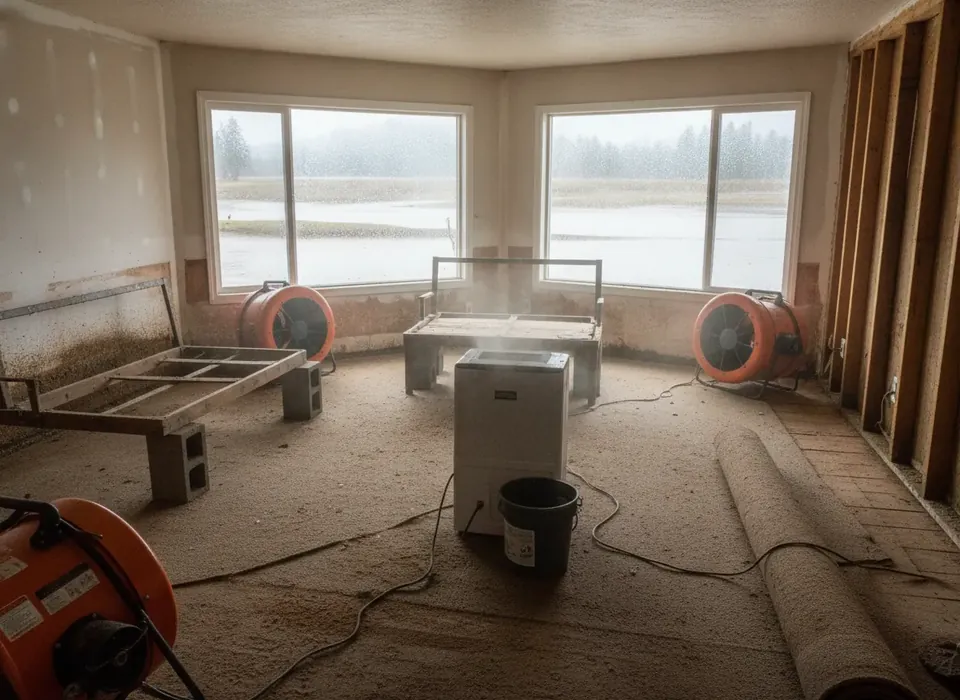
Fire, smoke and the mold that comes later
The CDI guide lists smoke as typically covered. Mold is a different matter. Homes that survived the 2017 Tubbs and Nuns fires or the 2020 Glass Fire sometimes took on firefighting water, and wet insulation that was never opened up can grow mold later. Smoke cleanup and mold remediation are separate scopes of work, and the mold part may not be covered even when the smoke claim was. Our fire rebuild moisture and mold page covers what to look for.
For wildfire claims, the guide also notes that additional living expenses are normally limited to 20% of the dwelling coverage, and that rebuild time limits are at least 12 months, or 24 months in a declared state of emergency. If you are still rebuilding, ask your insurer which deadlines apply to you.
What to do in the first few days
Stop the water
Shut off the supply, catch the drip or get a roof tarp up. Policies generally expect you to prevent further damage.
Document everything
Take photos and video of the water source, the damage and the mold before anything is moved. Note the date you found it.
Report promptly
Call your insurer or agent and ask for the claim number and the adjuster's name. Delay can make a sudden loss look like a slow leak.
Read your policy
Look for the words "mold," "fungi" or "microbes" in the policy and endorsements. Some policies carry a mold limit or an add-on; the amount varies.
Get written quotes
Adjusters usually want an itemized scope: containment, removal, drying, clearance and rebuild. Keep every invoice.
Our mold remediation cost guide lists published price ranges you can compare quotes against, and the water, flood and storm mold page explains what companies typically do after a leak.
If the claim is denied
Ask the insurer to put the denial in writing and to quote the policy language it relies on. You can ask your agent to explain it, and the California Department of Insurance takes consumer questions and complaints about claims handling. For a large or disputed loss, a California attorney can review the policy. None of this is legal advice.
Renters and landlords
A landlord's policy covers the building, and a renter's policy usually covers belongings, with the same general exclusions for mold, seepage and flood. Repairs to the unit are generally the landlord's job. See our guide to California renters' mold rights.
Insurance and mold questions
Does homeowners insurance cover mold in California?
Usually not on its own. The California Department of Insurance guide lists mold among perils that are usually excluded. If mold follows a sudden and accidental water loss that the policy covers, such as a burst supply line, some cleanup may be handled within that claim, subject to the policy's wording and limits. Only your insurer can say what your policy will pay.
Is mold from a slow leak covered?
Usually not. The CDI guide lists water damage caused by seepage or leaks as not covered, and slow drips under sinks, behind toilets or through a worn roof usually fall into that category. Reporting water as soon as you see it helps, because a claim filed months later can look like long-term seepage even if it started with one storm.
Does insurance cover mold after a flood?
Not under a standard homeowners policy. The CDI guide says flood coverage is generally not provided in homeowners or renters policies. Separate flood insurance through the National Flood Insurance Program covers flood damage up to $250,000 for the structure and $100,000 for contents. Whether that policy pays for mold depends on its own terms, so ask your flood insurer.
Will my insurer pay for mold testing?
Sometimes, as part of a covered water claim, but many policies limit or exclude mold-related costs. Ask your adjuster before you order lab tests, and get the answer in writing. California does not set mold exposure limits, so testing is mainly useful to find hidden growth or confirm a cleanup. See our mold inspection and testing page.
Need quotes to share with your adjuster?
Describe the water source, the rooms affected and roughly how much mold you see, and independent companies serving Santa Rosa, Petaluma, Windsor and the rest of Sonoma County will reply with free quotes. Request a free quote or call (707) 896-6015. Santa Rosa Mold Pros is a free quote service: we pass your request to independent Santa Rosa, California area companies, and we do not inspect, remove mold or do construction work ourselves.