
Mold After Floods, Storms & Leaks in Santa Rosa, CA
Water came in during a storm, a pipe burst, or the river rose. Describe what got wet and independent Sonoma County companies reply with free quotes for drying and mold removal. Here is what to do first and what to expect in Santa Rosa, California.
Get a Free Quote Call (707) 896-6015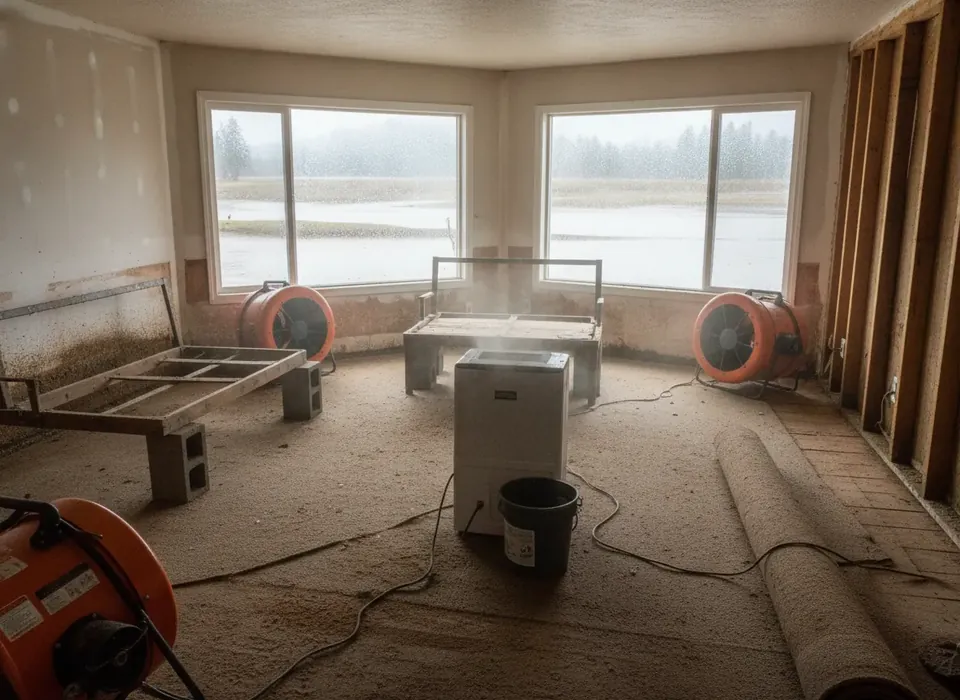
Water first, then mold
Mold after water damage is a timing problem. The EPA advises drying wet materials within 24 to 48 hours. Beyond that, drywall, insulation, carpet pad and cabinet bases can start growing mold inside, where you cannot see it.
So the order matters: stop the water, get it out, dry the structure, and only then decide what has to be removed. Many companies the site connects you with handle both water mitigation and mold remediation; others do one or the other.
If the water was weeks ago and you are now smelling something, start with a mold inspection. Water in the attic or under the floor? See attic mold and crawl space mold.
Sonoma County water events
Atmospheric rivers. Santa Rosa gets about 83% of its yearly rain from November through March, often in a few big storms. December and February average more than six inches each. Roofs, windows and decks that are fine all summer get tested hard in a single week.
Russian River floods. On February 27, 2019, the Russian River at Guerneville crested at 45.38 feet, more than 13 feet above flood stage. The record is 49.5 feet in 1986. Sonoma County's early estimate put damage near $155 million with about 1,900 homes affected. Guerneville, Monte Rio and Forestville homes, many of them older cabins, see this water first. See the Guerneville and Russian River page.
Low ground and creeks. The Laguna de Santa Rosa floods often in winter and can reach low-lying homes on Sebastopol's east side, and parts of Petaluma sit near the Petaluma River.
Declared disasters. Sonoma County was included in federal disaster declarations for winter storms in 2017, 2019 and January 2023. The 2023 storms were mostly roof leaks, fallen trees and saturated crawl spaces rather than a river disaster, and many of those leaks only showed up later as stains and smells.
Everyday leaks. Burst supply lines, water heaters, washing machine hoses and dishwasher leaks do not wait for storms.
What water damage and mold companies typically do
Extract and assess
Pump or vacuum standing water, map how far it wicked into walls and floors, and identify the water category: clean supply line water, gray water, or floodwater.
Remove soaked porous material
Carpet pad, insulation and the bottom of drywall are usually cut out, especially after floodwater. This is called a flood cut.
Dry the structure
Air movers and dehumidifiers run, often for several days, with daily moisture readings recorded.
Contain and remove mold
If growth has started, the area is sealed, run under HEPA filtration, and moldy material is removed and cleaned.
Verify and rebuild
Final dry readings and a clearance check, then rebuild by a CSLB-licensed contractor, with a permit where required.
Insurance: sudden water versus slow leaks
The California Department of Insurance's residential guide (revised January 2026) says mold is usually excluded from homeowners policies. Sudden and accidental water damage is typically covered, while water damage from seepage or leaks usually is not. Flood is generally not covered by a homeowners or renters policy at all; it needs separate flood insurance. Coverage on your claim depends on your policy, so photograph everything, keep damaged samples if you can, and report promptly. Do not assume a company's estimate means the insurer will pay it.
Watch for storm chasers
After big storms, door-knockers appear. In California, any job of $1,000 or more, or any job needing a permit, requires a CSLB-licensed contractor, and unlicensed contracting for disaster repairs is a crime. For repairs after a declared emergency you generally get seven days to cancel the contract, and the down payment generally cannot exceed $1,000 or 10% of the price, whichever is less.
What it costs
| Item | Typical range | Source |
|---|---|---|
| Typical whole job | $1,500–$9,000 (national avg ≈ $3,500) | Fixr 2025 |
| Average job (second guide) | $1,200–$3,750 (avg ≈ $2,300) | This Old House 2026 |
| Small area ≈ 50 / 100 / 200 / 500 sq ft | $500–$1,250 / $1,000–$2,500 / $2,000–$5,000 / $5,000–$12,500 | This Old House 2026 |
| Whole house | $10,000–$30,000 | Fixr 2025 |
Drying equipment rental days, the amount of drywall and flooring removed, and rebuild all move the number. For a planning range, use the cost calculator.
Right now, if water just came in
- Stay safe: turn off power to wet areas if you can do it without standing in water.
- Stop the source: shut the main water valve, or tarp the roof once the storm passes.
- Photograph and video every room before moving anything.
- Get air moving and call for drying quotes within the first day or two.
- Keep children and pets out of floodwater and wet rooms.
Questions to ask every company
- What is your CSLB license number, and which classification covers this work? (Check it on CSLB's license lookup before you sign.)
- Can I have a written contract with the full price, the scope, and the three-day cancellation notice?
- Is the down payment within the California cap: $1,000 or 10% of the price, whichever is less?
- How will you confirm the job is done: a visual check, moisture readings, or clearance testing by someone independent?
- Will you record daily moisture readings and share them for my insurance claim?
- Is this a repair after a declared emergency, and does the contract show my seven-day cancellation right?
Get water damage and mold quotes in Santa Rosa, CA
Tell us what got wet, when, and where the water came from. We pass it to independent water damage and mold companies in Santa Rosa and Sonoma County, and they reply with quotes.
Independent Sonoma County companies reply to you directly. No obligation, and you choose who to hire. Prefer to talk? Call (707) 896-6015
Water, flood and storm mold questions
How soon after a leak or flood does mold grow?
The EPA advises drying wet building materials and furnishings within 24 to 48 hours to prevent mold growth. After that window, assume porous materials such as drywall, insulation, carpet pad and particleboard may be growing mold even if nothing is visible yet. Fast water removal and drying cost far less than remediation later.
Does homeowners insurance cover mold after a storm in California?
It depends on the cause. The California Department of Insurance says mold is usually excluded, sudden and accidental water damage is typically covered, and long-term seepage or leaks usually are not. Flood from rising water needs separate flood insurance. Mold that follows a covered sudden loss may be treated differently. Read your policy and ask your insurer.
Can I cancel a contract I signed right after a disaster?
Generally, yes. California law gives homeowners seven days to cancel a contract for repair or restoration of a home damaged in an event with a declared state of emergency, instead of the usual three. Unlicensed contracting for disaster repairs is also a crime in California. Check any license on CSLB's license lookup before you sign.
What should I throw out after a Russian River flood?
Floodwater is dirty water, so porous items it soaked, such as carpet, pad, upholstered furniture, mattresses, insulation and the lower part of drywall, are usually removed rather than cleaned. Solid wood and hard surfaces can often be cleaned and dried. Photograph everything before it goes to the curb for your insurance claim.
Seeing or smelling mold? Get a clear plan.
Free, no-pressure quotes from independent companies across Santa Rosa, Petaluma, Rohnert Park, Windsor and Sonoma County.