
You rent in Santa Rosa, California and there is mold on a wall, around a window or under the sink. This guide walks through the California statutes on whose problem it is, how fast it should be fixed and what you can do if nothing happens.
General information, not legal advice. Santa Rosa Mold Pros is a free quote service, not a law firm. The rules below are summarized from the California Civil Code and Health and Safety Code as published in October 2026. Before you withhold rent, deduct a repair or move out, talk to a California attorney or a local tenant resource about your own situation.
About 43% of Santa Rosa homes are renter-occupied, and in Rohnert Park about half. With roughly 83% of the rain falling November through March, leaks and damp walls tend to show up in winter.
Is mold the landlord's responsibility in California?
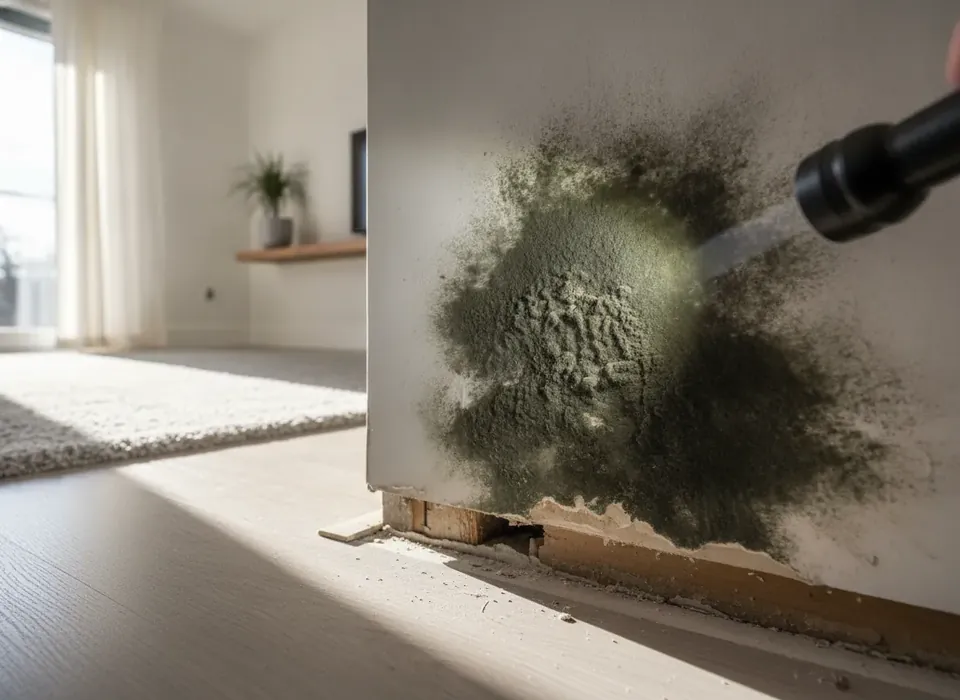
Often, yes. In 2015 the Legislature passed SB 655, which took effect January 1, 2016. It added mold to the list of conditions that can make a building substandard under Health and Safety Code 17920.3(a)(13). That subsection covers "visible mold growth, as determined by a health officer or a code enforcement officer."
Three details matter:
- It has to be visible. The law does not use lab counts or air tests. California never adopted mold exposure limits, so officers look at what they can see.
- An official makes the call. The substandard finding comes from a health officer or code enforcement officer, not from the tenant, the landlord or a mold company.
- Minor mold in normal wet spots is excluded. The statute leaves out minor mold on surfaces that collect moisture as part of their normal use, such as, in many readings, a little mildew on shower caulk.
Civil Code 1941.1 ties this to the landlord's basic repair duty. A dwelling is "untenantable" if it substantially lacks effective waterproofing and weather protection of the roof and exterior walls, plumbing in good working order, or if it is a unit described in Health and Safety Code 17920.3. In practice, the leak that feeds the mold is often the bigger legal issue than the mold itself.
When does the landlord's duty start?
Civil Code 1941.7, also added by SB 655, says the landlord's duty to repair mold under 17920.3(a)(13) does not arise until the landlord has notice of it. It also does not arise if the tenant is in violation of Civil Code 1941.2, which lists the tenant's own upkeep duties, such as keeping the unit reasonably clean and using fixtures properly.
The same section lets the landlord enter the unit to fix mold after giving notice under Civil Code 1954. Under that section, 24 hours' written notice is presumed reasonable.
So the first practical step is simple: tell the landlord, in writing, and keep a copy.
How to report mold to your landlord
Take dated photos
Photograph the mold, the surrounding area and any water source: a ceiling stain, a dripping trap, a fogged window. Include something for scale.
Write it down
Send an email or letter that says where the mold is, roughly how big it is, when you first saw it and any leak you suspect. Ask for a repair and a time to come in.
Keep copies
Save your message, any reply and the dates. If you talk by phone, follow up with a short email that sums up the call.
Allow access
Let the landlord or their contractor in after proper notice. Refusing access can weaken your position later.
Limit the damage
Run bath fans, wipe condensation and report new leaks right away.
How long does a landlord have to fix mold in California?
There is no single deadline written for mold. The general repair statute, Civil Code 1942, uses a "reasonable time" after notice, and it presumes that acting after 30 days is reasonable. A tenant or attorney may argue that a shorter time fits an urgent situation, such as an active leak, but that depends on the facts.
Repair and deduct, withholding rent and moving out
California gives tenants some remedies, but each has conditions. Getting them wrong can lead to an eviction case, so read this as an outline only.
| Remedy | What the statute says, in short | Key conditions |
|---|---|---|
| Repair and deduct (Civ 1942) | After notice and a reasonable time, the tenant may pay for the repair and deduct it from rent, up to one month's rent | No more than twice in 12 months; not available if the tenant caused the problem |
| Vacate (Civ 1942) | After notice and a reasonable time, the tenant may move out instead | Same notice and reasonable-time rules; talk to an attorney about the lease |
| Rent limits on substandard units (Civ 1942.4) | A landlord may not demand or collect rent, raise rent or serve a 3-day notice to pay or quit on a substandard unit | Applies only when a public officer has notified the landlord in writing to fix the condition, among other conditions |
Summary of California Civil Code sections 1942 and 1942.4. Not legal advice; the full text and a lawyer's reading control.
Because 1942.4 depends on a public officer's written notice, renters often contact code enforcement before doing anything with the rent.
Bringing in code enforcement or the health officer
For rentals inside Santa Rosa city limits, the City of Santa Rosa's code enforcement staff handle housing complaints. Unincorporated areas such as Guerneville, Forestville or Larkfield-Wikiup go through Sonoma County, and Petaluma, Rohnert Park, Windsor, Sebastopol, Healdsburg, Sonoma and Cotati each have their own city offices. Check the city or county website for the current contact before you call.
Does a renter need mold testing?
Usually not to prove the problem. Because SB 655 is built on visible mold, a clear photo and an officer's inspection carry more weight than an air sample. The Toxic Mold Protection Act also says landlords are not required to test, and its disclosure duties depend on exposure standards the California Department of Public Health never adopted. Testing can still help find hidden growth or check a cleanup. Our posts on whether you need mold testing and what California mold laws require go into more detail.
For landlords: what a clean fix looks like
- Respond in writing and schedule entry with proper notice.
- Find and fix the water source first: roof, window, plumbing or drainage.
- For mold work of $1,000 or more, or any job that needs a permit or a crew, hire a CSLB-licensed contractor. Our guide to hiring a CSLB-licensed contractor covers contracts and payments.
- In buildings from before 1981, ask about an asbestos survey before drywall or flooring comes out.
- Keep the invoice, scope of work and any clearance results with the unit's records.
See our rental and tenant mold page and the mold remediation cost guide.
A note on health
The EPA and CDC say mold can irritate the nose, throat, eyes and skin of sensitive people, and can be more serious for people with asthma or weakened immune systems. If anyone in the home has symptoms, see a doctor.
Renter mold questions
Can I withhold rent for mold in California?
Only under narrow conditions. Civil Code 1942.4 bars a landlord from collecting rent on a substandard unit when a public officer has notified the landlord in writing to fix it, among other conditions. Civil Code 1942 allows repair and deduct after notice and a reasonable time. Withholding without meeting those rules can lead to eviction. Talk to a California attorney or tenant resource first.
How long does a landlord have to fix mold in California?
No deadline is written specifically for mold. Civil Code 1942 uses a reasonable time after the landlord gets notice, and acting after 30 days is presumed reasonable. Urgent situations, such as an active leak, may call for faster action. Put your notice in writing and keep a copy, because the landlord's mold repair duty starts on notice under Civil Code 1941.7.
Can I break my lease because of mold?
Civil Code 1942 lets a tenant vacate when the landlord does not make needed repairs within a reasonable time after notice, but the details matter, including whether the tenant caused the problem and what the lease says. Moving out without following the steps can leave you owing rent. This is general information, not legal advice; ask a California attorney or local tenant resource.
Does renters insurance cover mold?
Usually not for the mold itself. The California Department of Insurance guide lists mold among perils usually excluded, and the building is the landlord's responsibility. A renters policy may help with your belongings if a covered, sudden water event caused the damage. Read your policy and ask your agent. Our post on insurance and mold explains the same rules.
Need a mold assessment or remediation quote?
Landlords, property managers and tenants can describe the unit, the leak and the rooms affected, and independent companies across Santa Rosa, Rohnert Park, Petaluma and Sonoma County will reply with free quotes. Request a free quote or call (707) 896-6015. Santa Rosa Mold Pros is a free quote service: we pass your request to independent Santa Rosa, California area companies, and we do not inspect, remove mold or do construction work ourselves.