
How a Mold Remediation Job Works in Santa Rosa, CA
From the first call to the last coat of paint, here is what a typical mold job looks like when it is done carefully, and the questions to ask at each step. Santa Rosa Mold Pros is a free quote service; the independent companies you hire do the work.
Get a Free Quote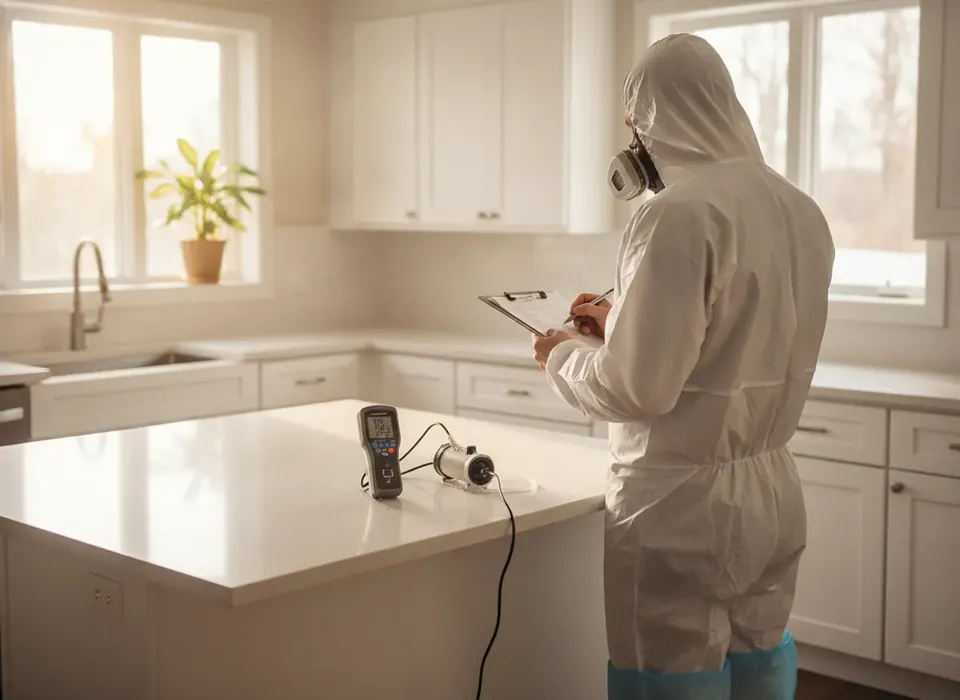
The short version
Find the water, fix the water, remove what is moldy without spreading it, dry everything, confirm it is clean, then rebuild. Every good mold job in Santa Rosa, California follows that order, whether it is a 20 square foot bathroom ceiling or a flooded Guerneville cabin.
California does not issue a mold-specific license and has no state remediation standard, so the quality of the job depends on the company and on what you put in writing. The steps below give you a yardstick for comparing quotes.
Prefer the cost side first? See the mold remediation cost guide.
Eight steps, start to finish
Send one request
Use the free quote form or call. Say where the mold is, roughly how big it looks, what got wet and when, the age of the house, whether there is a crawl space, and whether you own or rent. Independent companies serving Santa Rosa, CA and Sonoma County reply to you directly.
Inspection and moisture mapping
Someone looks at the visible mold and, more importantly, finds the water. Expect moisture meter readings, often thermal imaging, a look in the crawl space or attic, and samples only when they answer a real question. Ideally this is an inspector who does not also sell the removal, so the scope is not written by the company that profits from it.
Written scope and contract
You get a written scope: what will be removed, how the area will be contained, how drying will be confirmed, and whether clearance and rebuild are included. Jobs of $1,000 or more, jobs needing a permit and jobs with employees require a CSLB-licensed contractor, so the license number belongs on the contract. The down payment generally can't exceed $1,000 or 10 percent, whichever is less.
Containment and negative air
The work area is sealed with plastic sheeting and zipper doors, and an air scrubber with a HEPA filter pulls air out of the space so spores do not drift into the rest of the house. Supply and return vents in the area are covered, and the HVAC system is usually shut off.
Removal and cleaning
Moldy porous materials such as drywall, insulation, carpet and pad are cut out, bagged and removed. Framing and other hard surfaces are HEPA-vacuumed and cleaned. Good crews remove a margin beyond the visible stain because growth often extends further inside the wall.
Drying
Dehumidifiers and air movers run until framing and subfloor read dry. The source of the water must be fixed first: a roof repair, a plumbing repair, crawl space drainage or a vent fan. Without that, mold comes back no matter how well the cleanup went.
Clearance check
Before walls close, someone confirms the area is clean and dry. That can be a visual check with moisture readings, or air and surface samples compared with outdoors or an unaffected room. California sets no numeric mold limit, so an independent second look is the main value here.
Rebuild with a licensed contractor and permit where required
New insulation, drywall, paint and flooring go back in. Rebuild work of $1,000 or more, or work needing a permit, must be done by a CSLB-licensed contractor. The City of Santa Rosa requires a permit unless the California Building Code exempts the work; Permit Sonoma exempts minor drywall repair only up to 100 square feet in unincorporated areas. Ask the company or your building department.
Questions to ask any mold company
- What is your CSLB license number, and what classification is it? (Check it on the CSLB license lookup.)
- Where is the water coming from, and who fixes that?
- How will you contain the area and filter the air?
- What exactly will you remove, and how far past the visible mold?
- How will you prove the area is dry before you close it up?
- Is clearance included, and who does it? Can it be someone independent?
- Does the price include rebuild? Who pulls any permit?
- If the house was built before 1981, will you test for asbestos before tear-out? Before 1978, is your firm EPA Lead-Safe Certified?
- How much is the down payment? (Generally no more than $1,000 or 10 percent, whichever is less.)
After a fire, flood or big storm
Contracts to repair damage from a declared disaster generally carry a seven-day right to cancel, and unlicensed disaster repair work is a crime in California. If someone knocks on your door after an atmospheric river or a fire and wants cash today, slow down and check the license first. See floods, storms and leaks.
Want to understand testing before you call anyone? Read mold inspection and testing or the FAQ.
Seeing or smelling mold? Get a clear plan.
Free, no-pressure quotes from independent companies across Santa Rosa, Petaluma, Rohnert Park, Windsor and Sonoma County.